

Development Sweden #89. Could Carl Skau become the ‘real’ head of the WFP?
A newsletter on Swedish development cooperation and policy

Dear readers,
Welcome back to a new issue of Development Sweden. Swedish diplomat Carl Skau has been appointed acting head of the UN World Food Programme (WFP). Could the tug-of-war between the US and the EU lead to him eventually getting the job “for real”? Sida’s new staff survey reveals widespread dissatisfaction among staff. Read what the research says about linking migration and aid – is it feasible, and what happens when Sida chooses to break the DAC’s rules on what counts as aid?
Also, in this issue. Sida is to move out of its premises in Rissne and may move back to the city centre. The government has now decided this.
Development Sweden provides you with exclusive insight into everything happening in Swedish aid policy every other week. Development Sweden relies on readers like you. If you would like to read the full newsletter, you are most welcome to upgrade to a paid subscription.
David Isaksson
Editor-in-Chief, Global Bar Magazine
What do you think we should write more about? Please send us your feedback and suggestions. Write to: david@globalreporting.net
For subscription-related issues, contact: info@globalreporting.net
Our headlines
Widespread dissatisfaction among Sida staff
Could Carl Skau become the ‘real’ head of the WFP?
Aid and migration – what does the research say?
Sida wants to fast-track migration funding before the election
Migration funds allocated to an organisation that “risks Sida’s credibility”
Sida can move back from the suburb
Widespread dissatisfaction among Sida staff
Sida’s new staff survey reveals widespread dissatisfaction among staff. Sida ranks well below the public sector as a whole in terms of staff satisfaction. And only 13 per cent would genuinely recommend Sida as an employer.
Sick leave, managers resigning and a working environment that has not improved despite dialogue and discussions are some of the issues that have characterised Sida in recent years. In March 2025 , the chief health and safety representative also chose to file a complaint with the Swedish Work Environment Authority, as they felt the employer lacked the will to improve the situation.
The results of Sida’s 2026 employee survey, conducted by the consultancy firm Netigate, have now been presented.
The survey, which was carried out between 26 March and 15 April 2026, is based on Netigate’s engagement model, and measures various drivers of engagement in the workplace, in most cases on a five-point scale. In addition to engagement, the consultancy firm has also included questions specific to Sida. For comparison, figures from 2025 are provided, as well as Netigate’s own ‘public sector benchmark (1,016 responses)’.
Of Sida’s 656 employees, 577 took part, giving a response rate of 88 per cent. Of those who responded, 74 per cent were women.
In response to the overarching question “I am generally satisfied with my employer”, the score for Sida was 3.39, which is higher than in 2025 when the figure was 3.12. In the public sector as a whole, however, the figure is 3.72, meaning that Sida is below average in terms of employee satisfaction.
Few recommend Sida
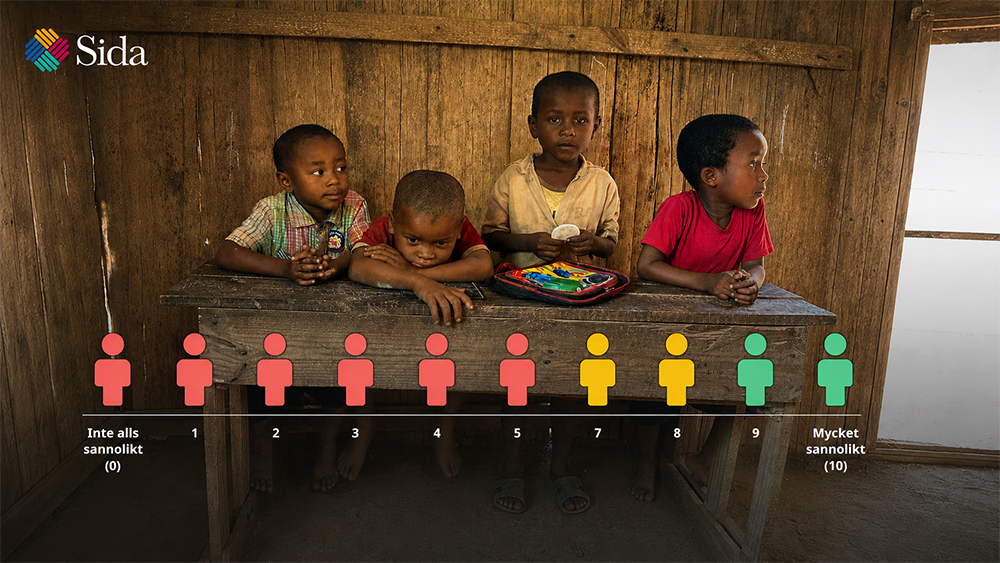
When asked “how likely are you to recommend Sida as an employer (image at the top of the article) to others”, 62 per cent answered, “not at all likely”, whilst only 13 per cent stated, “very likely”. The average for the public sector is 35 per cent (not) and 30 per cent (very) respectively
Areas receiving particularly low scores are trust in management and internal communication. Despite this, trust has increased since 2025, the survey shows.
When it comes to how individuals view their role, Sida ranks below the public sector as a whole in all areas. However, Sida employees feel a greater sense of community with their colleagues than is generally the case within the public sector. Sida employees also hold their immediate managers in high regard.
